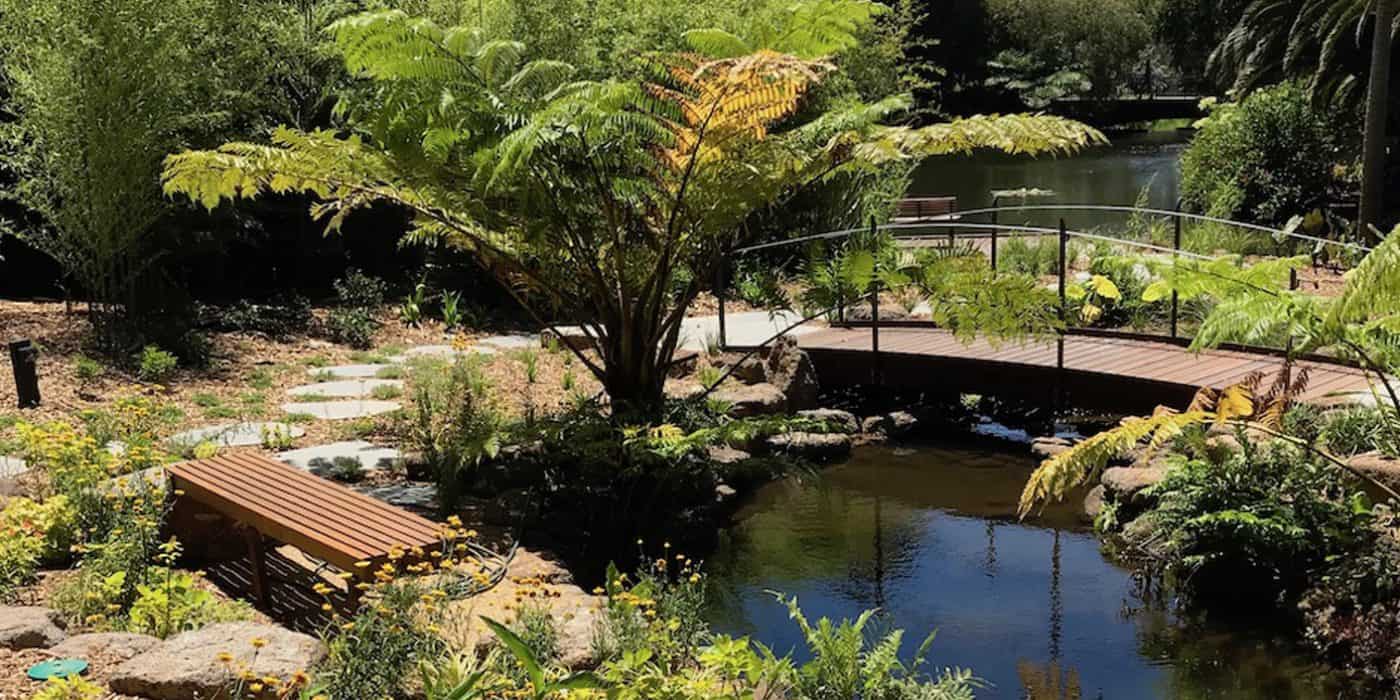
Sensory Garden

We were excited to see the Sensory Garden officially open on 17 December 2020, when Peter Kelly, former Chair of the Friends of the Royal Botanic Gardens Melbourne Trust Fund, the project’s major donor, shared the honour of cutting the official ribbon – a length of vine – with RBGV Chair, Ms Chris Trotman. RBGV Director and Chief Executive, Professor Tim Entwisle also officially launched the RBGV Melbourne Gardens Master Plan 2020-2040 at the same time.

Donors and other guests were given a tour of the new garden by Landscape Architect Andrew Laidlaw and horticulturist Terry Smyth, and it was pleasing to see plants contributed by the Growing Friends nursery as part of the landscaping. The garden gives visitors a place of quiet contemplation overlooking the water of Central Lake as well as a place to enjoy the different sensations of colour, scent, sound and texture, from the rustling of bamboo to the scent of thyme under foot.

The FRBGM Trust Fund grant of $200,000 towards the Sensory Garden helps to complete the Melbourne Gardens’ Fern Gully Restoration Project. This has been a major area of financial support from the Trust Fund over several years, with previous grants going towards the Fern Gully Boardwalk ($300,000), rainforest misting ($52,000) and the Fern Gully Rest House restoration ($75,000).

The Friends are proud to have been able to contribute to the redevelopment of this important precinct within the Melbourne Gardens.

The Nareeb Gates

The beautiful Nareeb Gates are back in place at D Gate. They have recently been restored to their former glory with the aid of generous donors, a project the Friends’ Trust Fund was also pleased to contribute to. Apart from the refurbished, shiny gold decoration, one of the gates’ most striking features are the tall gas lamps adorning both pillars. They will also shine again – but not with gaslight!

These ornate gates were manufactured in England, probably in the 1870s, started life in Melbourne with the land boom of the 1880s, and became part of one of the many grand Victorian estates recalled now only in the names of streets and courts around South Yarra, Toorak and nearby suburbs. The early ownership of the Nareeb estate at 166-170 Kooyong Road, Toorak, was changeable. It began in 1875 when 5 acres of land were sold to a Western District squatter named Josiah Watson. He chose not to develop the property and in 1883/84 sold it to piano manufacturer Octavius Beale, who built the mansion then known as Sommariva in 1888, under architect William Salway. Beale moved to Sydney and between about 1890 and 1906 the estate, under the name of Oma, changed hands between John Grice, Frederick Cato and John’s twin brother James Grice. In those years Oma was described as standing in ‘fine well planted grounds with handsome, elaborate scroll-work entrance gates (set in ornamental brick walls) opening onto a serpentine drive.’ (Stonnington History News, newsletter no.36, Oct-Nov 2001). In 1906 the estate was purchased by Walter Simmonds and renamed Nareeb. Simmons had become wealthy through property purchases and gold interests around Stawell in western Victoria. Among his properties for a few years had been Nareeb Nareeb at Glenthompson.

Nareeb in Toorak entered a period of stability and remained in the family’s ownership until the death of Miss Gertrude Simmons in 1964, when the 5-acre property was sold by the trustees. The National Trust had classified the house as ‘interesting, preservation desirable’ but fortunately Gertrude Simmons had asked that the gates be given to the National Trust to ensure their preservation, for the enjoyment of future generations. The mansion was opened to the public to raise funds for the National Trust in December 1964, with many thousands of Melbournians paying the 3 shilling fee and passing through the gates to see the historic property. The furnishings and fittings were sold at auction on site by Leonard Joel Pty Ltd a few days later. The property itself was sold, demolished and subdivided, becoming what is now Nareeb Court.

The gates were originally deemed significant as an excellent example of ironwork from the 1870s and presented to the RBG by the National Trust in 1966. They were officially declared open in November 1967 and are now listed on the Victorian Heritage Register as being ‘of historical significance as a symbol and a reminder of Melbourne’s heritage of large mansion estates, few of which now remain…… No other similar set of 19th century residential gates have been identified by heritage surveys in the City’. What stories those gates could tell!

The Floral Emblem of New South Wales – Waratah

How aptly named is the magnificent Waratah?

Well, in answer to the question, the First Nations people who originally lived in the area that became known as Sydney were the Eora people and they named this vibrant species – Waratah which means beautiful or a tree with red flowers in their language.  The botanical name, Telopea speciosissima is equally appropriate.  Telopea comes from the Greek telopos meaning seen from afar referring to the conspicuous flowers and speciosissima from the Latin speciosus meaning showy and issimus, most. 

On 24 October 1962, the Waratah, Telopea speciosissima was named the floral emblem of New South Wales.  This particular species is found within a radius of about 200 km around Sydney.

Today there are a number of hybrid species of the Waratah, however there is a white variation of the native species too.  In Gulpilil’s Stories of the Dreamtime, a female Wonga pigeon was out looking for her mate.  As she soared above the tree canopy she was attacked by a hawk.  Escaping its clutches, she flew over white Waratah flowers and her blood turned them red forever.  First Nations people also used the stalk of the Waratah to make their necklaces and the flower was immersed in water and the mix of the sap and the water was given to children as a tonic.

Adventurous botanists sailed on exploratory expeditions from England and Robert Brown, a Scottish born naturalist sailed with Sir Joseph Banks on the Matthew Flinders expedition to chart the coastline.  Brown named the genus and species in 1810 and kept the Eora name for the plant.  Robert Brown became Sir Joseph Banks’ librarian, and they may have been good buddies because when Banks died, Brown inherited his library and herbarium. 

The Waratah belongs to the Proteaceae family and it grows to between 3 and 4 metres high with dark, razored leathery leaves.  The Waratah naturally grows in sandy clay areas and is mainly pollinated by birds such as the Honey Eater which is attracted to the brilliant colour of the flowers and the abundant supply of nectar.  It flowers from September to November.  Nature has looked after this beauty because the seeds are winged for wind dispersal and there may be more than 250 seeds on one flowerhead in a good year.  After bushfires, which are common in its natural habitat, a Waratah can regenerate from its lignotuber – a woody swelling of its stem that lies partly or wholly under the ground.

The Waratah once flourished in many areas of the Sydney metropolitan area. Sadly, the survival of this native plant is due now to its existence in national parks, reserves and relatively inaccessible areas where it is protected.   It causes me to wonder about the changes that have occurred due to a combination of our urban and rural developments.  I wonder what this beautiful country once looked like. 

Although the Golden Wattle, Acacia pycnantha is the national emblem the Waratah was definitely a contender when a national floral emblem was being selected.  One of the reasons the Golden Wattle was chosen is that species are found all over Australia whereas the Waratah is native only to the south eastern parts of Australia.  Over the years, the Waratah has featured in postage stamp designs and in many works of art.  The magnificent stained-glass windows in Sydney’s Town Hall feature the Waratah.  In the sporting world, the Waratah is the mascot for the NSW Rugby Union team, The Waratahs.  A good friend spurred me on to discover why Waratah Bay on Wilson’s Promontory is so named.  It was named after a ship that was anchored there for repairs.

Waratah Day is on 26 September.

Christmas Catalogue now available

This year we have a range of gorgeous gifts to help you have everything sorted early for Christmas. From beautiful linen tea towels, bees wax wraps, delicious gift-wrapped soaps, the 2021 Friends’ Botanical Art Calendar, Friends; gift memberships and much more.

CLICK HERE to view the Christmas catalogue.

You can order ONLINE or use the order form in the catalogue to order via email or mail.  You can also order by phoning (03) 9650 6398.

Purchases can be delivered or you can use our ‘click and collect’ option to pick up your purchases from Gate Lodge on the dates outlined in the catalogue.
If you are purchasing online, to ensure you receive a reduced member’s price, be sure to log into the Friends’ shop via the website HERE (‘log in’ button is located in the top right hand corner). If you are purchasing using the order form, the reduced member’s price is already listed.

We hope you find plenty of wonderful gifts for your family and friends.

Celia Rosser Awards

The Celia Rosser Award was created to commemorate Celia’s significant international achievements as a botanical artist.

Celia is best known for her stunning illustration of ‘The Banksias’, a 3-volume monograph of the entire 76 species of the genus Banksia known at the time which is regarded as one of the most finest collections of botanical paintings in the world.

This Award reflects Celia’s achievements and is presented to exhibiting artists whose works show excellence in one or more aspects of the art form including the highest degree of scientific accuracy.

This year, we would like to congratulate the winners of this year’s Celia Rosser Award:

  • Dianne Emery – Amanita muscaria   
  • Joanne Knott – Banksia petiolaris

Dianne is a third time winner of the Celia Rosser Award which clearly demonstrates her exceptional talents as a botanical artist. 

Joanne Knott, is a first time award winner, but must feel an enormous sense of pride receiving this award from Celia for her painting of a Banksia. 

Additionally, Celia would also like to make Honourable Mention to the following artists:

  • Haya Alketbi – Pyrus sp

Haya is a student of Dianne Emery’s online botanic art classes conducted via the Friends of the Gardens.  Haya is based in the United Arab Emirates and gets up at 4am each Friday to attend her online classes.

  • Eunike Nugroho – ‘Graceful Garlic’

Eunike is from Indonesia.

  • Jennifer Taranto – Solanum beaceum (Tamarillo) 
  • Beverly Allen – Corymbia ficifolia cv cv 


Congratulations to all artists for this wonderful achievement.

To visit the TABI Exhibition, click here.

Artwork Selected for the State Botanical Collection

The Royal Botanic Gardens have selected six artworks for botanical art collection which is a component of the State Botanical Collection incorporating original artworks, manuscripts, archives and specimen collection.

Congratulations to the following artists:

  • Amanda Blake-Sutterby Amyema lilnophylla
  • Linda Lunnon Grevillea buxifolia
  • Tess Mahar Hydrangea macrophylla
  • Eunike Nugroho Paphiopedium fairrieanum (Fairries II)
  • Francoise Piquet-Vadon Iris germanica (Indigo Princess)
  • Lioudmila Volodina Vaccinium corybosum

These artworks have been purchased through donations from the Friends of the Royal Botanic Gardens Trust Fund and the RBGV’s Director’s Circle.

To visit the TABI Exhibition, click here.

Life Before the Fires

Before the harrowing bushfires in Australia over our most recent summer, Jan Woodman captured a moment when an area of virgin bushland in the Adelaide Hills was flourishing.

Jan recalls, “It was the most wonderful and magical area abounding with wildflowers, orchids, ferns and fungi.”

Sundews and helmet and mosquito orchids were often the first to flower in this area and Jan loved to include them in her botanical paintings.

Jan was heartbroken when this conservation park was decimated by fire but has since returned to see ‘brave little sundews flowering’ but feels the bushland will never be the same.

Jan is one of many artists in ‘The Art of Botanical Illustration’ who reflect their local bushland in their art and following Australia’s 2019/20 Summer fires, this process is even more important to capture species which may be rare, threatened or endangered.

View ‘Early Wildflowers from Porter’s Scrub (before the fires)’ to enjoy Jan’s memory of this special place. 

To visit the TABI Exhibition, click here.

Enjoy ‘The Art of Botanical Illustration’ during 2021

If you have fallen in love with the beautiful artworks within The Art of Botanical Illustration, why not pre-order a 2021 Botanical Art Calendar which will be ready for delivery in early October.  

Including some of the most outstanding artworks from the exhibition, this subline showcase of art is representative of artists from across the world.

The artworks of the two winners of the Celia Rosser Award, Dianne Emery and Joanne Knott are represented as are a diverse range of species across the year.

Presented in a new landscape format, the calendar also makes a perfect gift for birthdays and Christmas, especially for family and friends across the world.

A big thanks goes to all the artists who have allowed the Friends of the Gardens to use their artwork to produce this gorgeous publication.  Profits from the sale of the calendar assist the Friends to continue their support of the Royal Botanic Gardens Melbourne.

We hope you enjoy the calendar just as much as we did creating it.

Click here to preorder

Make Yourself a Cuppa and Enjoy Our Recorded Online Talks Now


Many of you have enjoyed our online talks over the last few months and have asked if we have recorded them. Well the answer is YES, we have and they are now loaded on our website for you to enjoy at your leisure.

Whether it be armchair travelling in Provence, enjoying the creations of the Chelsea Flower Show or learning how to care for your deciduous trees these talks provide another way for you to enjoy your Friends’ membership. So grab a cuppa, make yourself comfy on the couch and enjoy these wonderful talks.

To access these member benefits, you must be an active member of the Friends.

https://rbgfriendsmelbourne.tidyhq.com/public/pages/2021-online-talks-recordings/preview


An Update from the Gardens


The Royal Botanic Gardens Victoria has again made the difficult decision to close Melbourne Gardens and Cranbourne Gardens to all visitors, from 11.59pm Wednesday 5th August. Both Gardens will remain closed until further notice, opening as soon as it is safe and reasonable to do so.

Whist the RBGV know the Gardens play an important role in the wellbeing of all visitors, not the least offering a safe place to connect with nature and enjoy time with friends and family during this time they will continue to develop new ways to engage with the beautiful and healing Gardens digitally.

You can stay connected with the Gardens by visiting the Virtual Garden, where you will find many wonderful videos and stories.